Piazza San Sepolcro
M: Son of the CenturyPiazza San Sepolcro is the Milan setting associated with the formation of the Fasci Italiani di Combattimento on March 23, 1919. The gathering portrayed there was scarcely a hundred men, but the scene gives the square more than geographical importance: it becomes the point where Mussolini’s account binds postwar dislocation, the memory of mass death, and a new political movement.
Setting and Founding
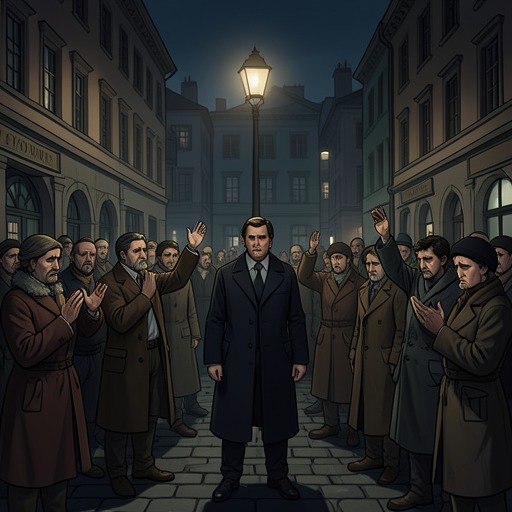
The book identifies Piazza San Sepolcro as the location of the formation meeting. Its opening image looks out over the piazza toward a sparse audience of men, while the scene also shifts into a nearly empty room where the speaker senses the crowd and waits to address it. The account does not present a large or settled organization at its birth; it emphasizes the smallness of the gathering and the uncertainty of what its speaker can say.
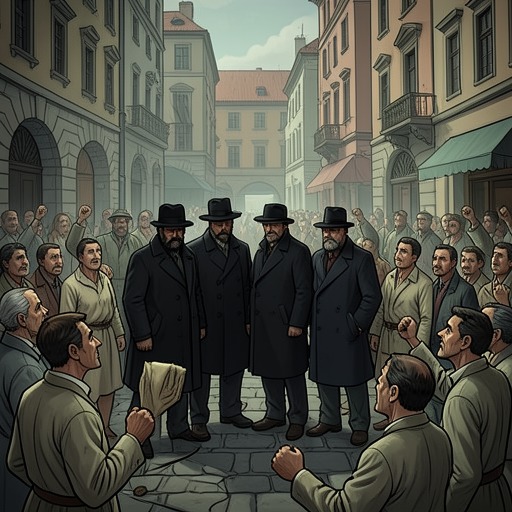
That modest scale is set against the immense human cost of the war. The imagined stage is submerged beneath the dead of the trenches, and the survivors are described as former soldiers and people left behind by carnage. The square’s founding significance thus arises from a sharp contrast: a small assembly stands amid the political and human consequences of a conflict on a vastly greater scale.
Veterans and Political Imagination
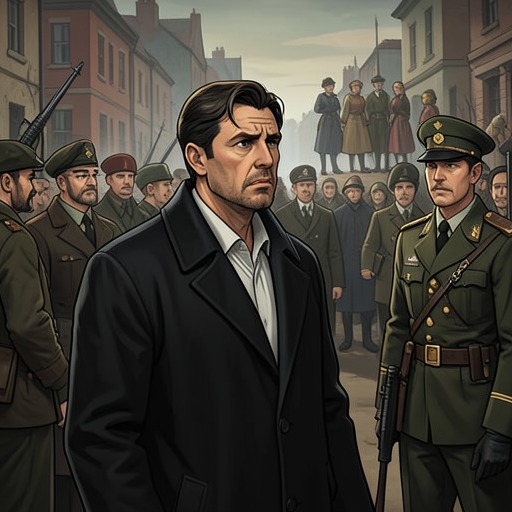
The scene casts the men assembled around the founding as a population of ex-soldiers, survivors, and social outsiders. They speak in short, forceful bursts, then fall silent; their shared experience of the front is presented as the basis of a collective identity rather than as a settled political program. The narrator’s figure at the center of the scene identifies himself with these demobilized and displaced men and reads the audience as the public for whom the new movement might speak.
The address also places the gathering within a wider postwar crisis. The return of five million soldiers is imagined as a force pressing upon the old political order, whose established speakers and moderates are portrayed as exhausted. The scene’s future-facing rhetoric makes the piazza a threshold: the veterans’ return is not simply an aftermath of war, but a condition from which a new alignment is anticipated.
A Place Recalled Through the Movement’s Origins
Piazza San Sepolcro recurs as a marker of the movement’s beginnings in the account of Olao Gaggioli. Before resigning as secretary of the Ferrara Fascio in December 1920, he is recalled as one of those present at the March 1919 gathering. The reference links the piazza’s founding moment to the later, contested development of local fascism, where Gaggioli’s departure was associated with opposition to Mussolini’s break with D’Annunzio and to agrarian interference.
This later recollection gives the square a meaning beyond the first meeting. It stands for an origin that participants could invoke even as the movement changed and its internal disagreements sharpened. In the book’s account, the piazza is therefore both a concrete Milan setting and a compact emblem of an unstable beginning: a small gathering of war survivors from which a larger political project claimed to emerge.